Yasuo Takada
11/30/20234 min read

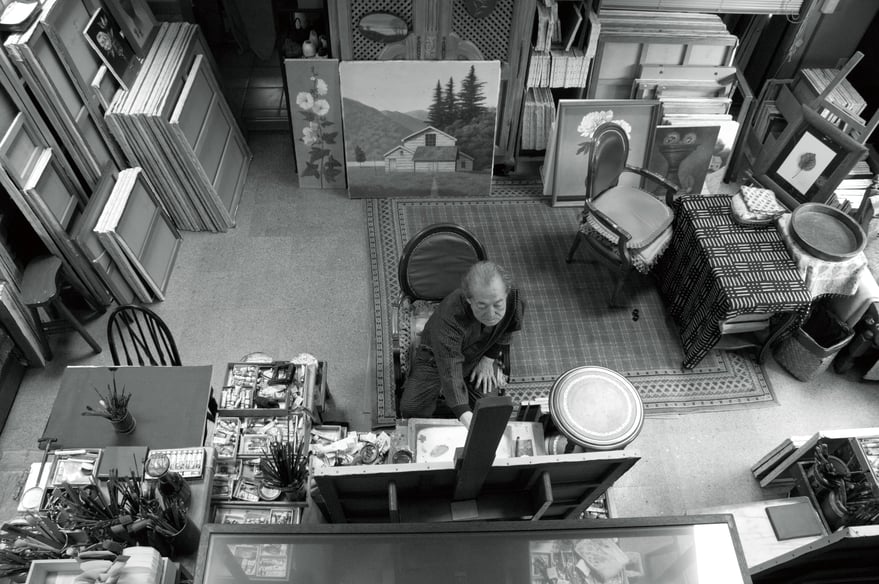
There are certain cultural factors that can influence both the way in which someone works, as well as the way that they perceive things. This is true in every country and region, and is also true in the world of art, which has been handed down from our distant ancestors. I would like to be able to introduce these ideas to more people, such that they can more fully appreciate the intent and beauty of what the artists were aiming to portray.
For example, since ancient times, Japanese culture has regarded the fragility of a falling flower as more beautiful than a flower in full bloom. Japanese paintings featuring camellias often depict them lying on the ground. Perhaps there are more paintings of flowers at the beginning of flowering or in decline than of flowers in full bloom.
Many different verbs exist to describe the withering of flowers:
“Cherry blossoms scatter”
“Plum blossoms brim over”
“Camellias tumble”
“Peonies collapse”
“Hydrangeas cling on”
“Morning glories wilt”
“Chrysanthemums dance”
So, what about people? Well, “people will go”.
I can't help but feel that this aesthetic sense is etched in the DNA of the Japanese people.
I want Yasuo’s art to reach not only Japanese people, but also everyone living on the earth, transcending national borders and the boundaries of time.
Nothing would please me more than to introduce Japan's unique aesthetic sense, culture and history to the world so that all people can enjoy his work.
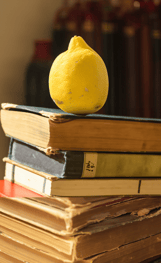
Let me introduce here “Lemon”, Motojiro Kajii's first book, published in 1925.
If you have never come across it, this is a short novel that I highly recommend reading.
The protagonist of the novel is a young man who is almost crushed by an unknown, ominous mass, but manages to endure it.
The lemons at a certain fruit shop he wanders into have a peculiar effect on his clouded thinking.
Early in the novel, the protagonist only describes the lemon visually, as being like yellow paint, squeezed from a tube and left to harden.
As the story progresses, his perception of the lemon extends to the senses of touch and smell.
He described it as cold enough to soak through his palms and with an intense aroma that made him think of California, where they were produced.
And then he comes to a realisation. Within the confines of his mind, the lemon, with its solid presence, counterbalances the mysterious, ominous mass' that haunts him.
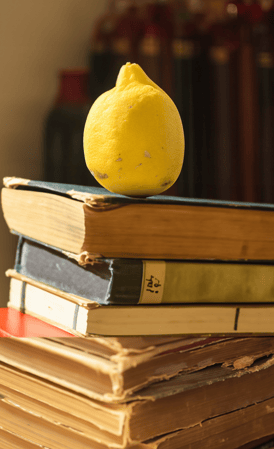
He goes to the bookshop that was the source of his melancholy, and uses the heavy books to symbolise the 'unidentifiable ominous mass', piling them up to the point that they equalled his trauma. Then the lemon, a golden bomb of unknown possibilities, was placed on top of the stack of books to blow away the 'unknowable ominous mass'. Then, the clouds that had shrouded his mind dispersed and a smile returned to his face.
For me, as a fourteen-year-old who had encountered Kajii Kanjiro's “Lemon”, the lemons in my real life were transformed into mystical fruit, in much the same way that, for those who know the story of Adam and Eve, apples may carry a meaning different from the apples imagined by those who do not.
I said earlier that the finest works of art do not require explanation, however I believe that there must be those out there whose own experiences mean that their perception is different, and as such I think it is worthwhile . Therefore, for those who have never encountered the landscapes and people depicted by Yasuo Takada, I will do my best to make known the background of his work and the cultural history of Japan.
We are enriched by learning from the outside of that which we do not possess, as well as by blurring the boundaries between ourselves and the outside.
Returning to the story, Yasuo Takada's paintings have this power. The objects Yasuo creates on canvas are no longer just objects. The nature, creatures and objects he paints are suffused in a faint, unassuming scent that touches the soul.
He is able to capture the beauty we might otherwise miss. Some may be soothed by that faint fragrance, some may feel nostalgic, or they may even miss it. Whatever emotion it may evoke within you, please enjoy this subtle, pleasant fragrance.
A true work of art needs no commentary.
Who cares about nutrition when enjoying the sweetness of the finest fruit?
Who cares about the origin of the fragrance of the most divine flower?
At best, only fruit farmers and perfumers would pay it any consideration.
There is no need for me to explain how awe-inspiring the art created by Yasuo Takada is.
Yasuo’s artwork requires no introduction, I simply invite you all to take a look for yourselves.
My mission is, instead, to present his work to those that have never encountered it.