Yasuo & Yokohama
11/30/20232 min read

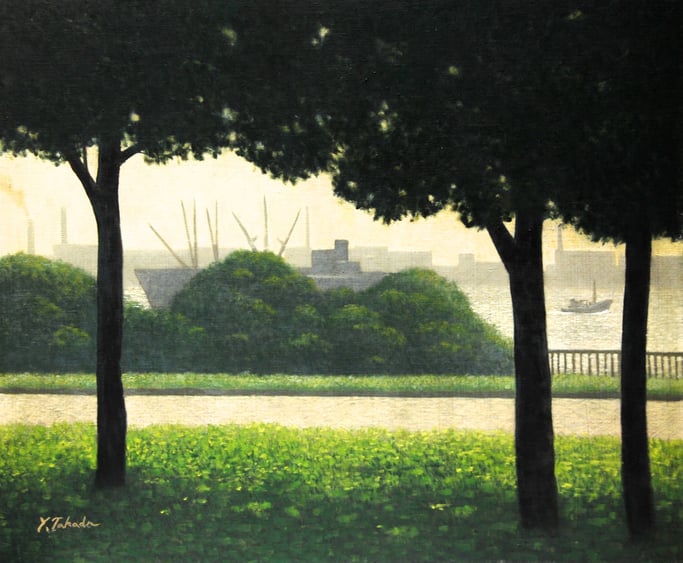
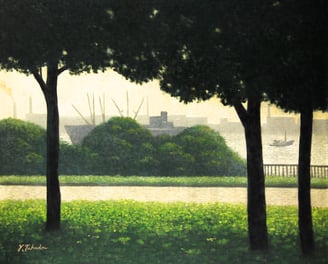
In 1945, he enrolled at Tokyo Fine Arts School (now Tokyo University of the Arts) and studied under Ryuzaburo Umehara, where he was able to showcase and hone his gift for oil painting.
However, on the morning on 29 May, 1945, what we now know as the Great Yokohama Air Raid tore his life apart. In the space of just 1 hour and 9 minutes, he lost his father, his home and the family business, and for the first time in his life he understood the true meaning of despair.
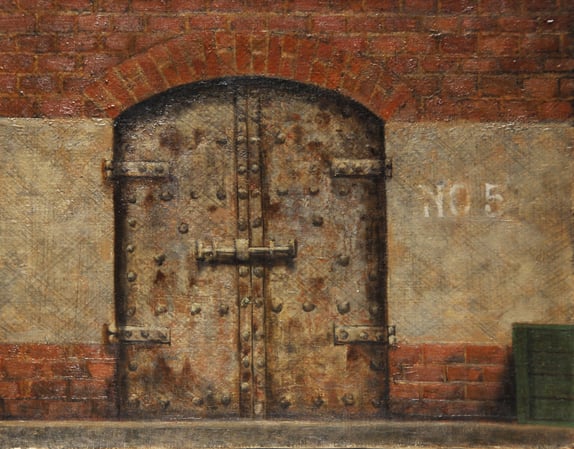
On the 15th of August, on the day that the war ended, he was holding a copy of Liberté, a poem written by French poet Paul Éluard, and was inspired to depict what was left of Yokohama. The air raids that devastated the city also mercilessly burnt down the red-brick warehouse where the Takada family stored their cotton stock. Yasuo had to face the heavily scarred iron door of the brick warehouse, and channeled the emotions he felt at that time onto paper.
He later published “煉瓦倉庫の扉 F10 号” (Renga souko no tobira F-10 / 1975-78) on the basis of this sketch.
Yasuo might have been thinking about what once existed on the other side of the heavy, gnarled iron door and his precious memories while painting it. Maybe he envisioned something inside the red-brick warehouse in his mind. Who knows? His paintings not only portray the reality of the moment, but also evoke within the viewer thoughts of what came before, and what might come to pass in the future. By capturing all of this in paint, his works assume the mantle of a requiem.
YOKOHAMA
The Takada family blossomed into an influential cotton merchant, and were also blessed with six children. Born in 1927, the youngest, Yasuo, flourished in the field of art. Yasuo grew up in, what seemed to onlookers, an idealistic environment. The success of the family’s business was such that it was often said that those from the north of Japan had only ever slept on the futons of Takada’s cotton. 1940 marked the beginning of a difficult period for Japan, seeing their relationship with the West deteriorate, which had a profound impact on the livelihoods of merchants. His art teacher, Rokushu Mizufune, spotted Yasuo’s exceptional talent and convinced him to follow the path of art, despite the multitude of other avenues he was presented with. As a result of this mentorship, drawing became a core aspect of Yasuo’s life.